
For Schools · 14 December 2025 · Updated 12 September 2026
Positive Energy Circulation Theory: a framework for sustainable motivation
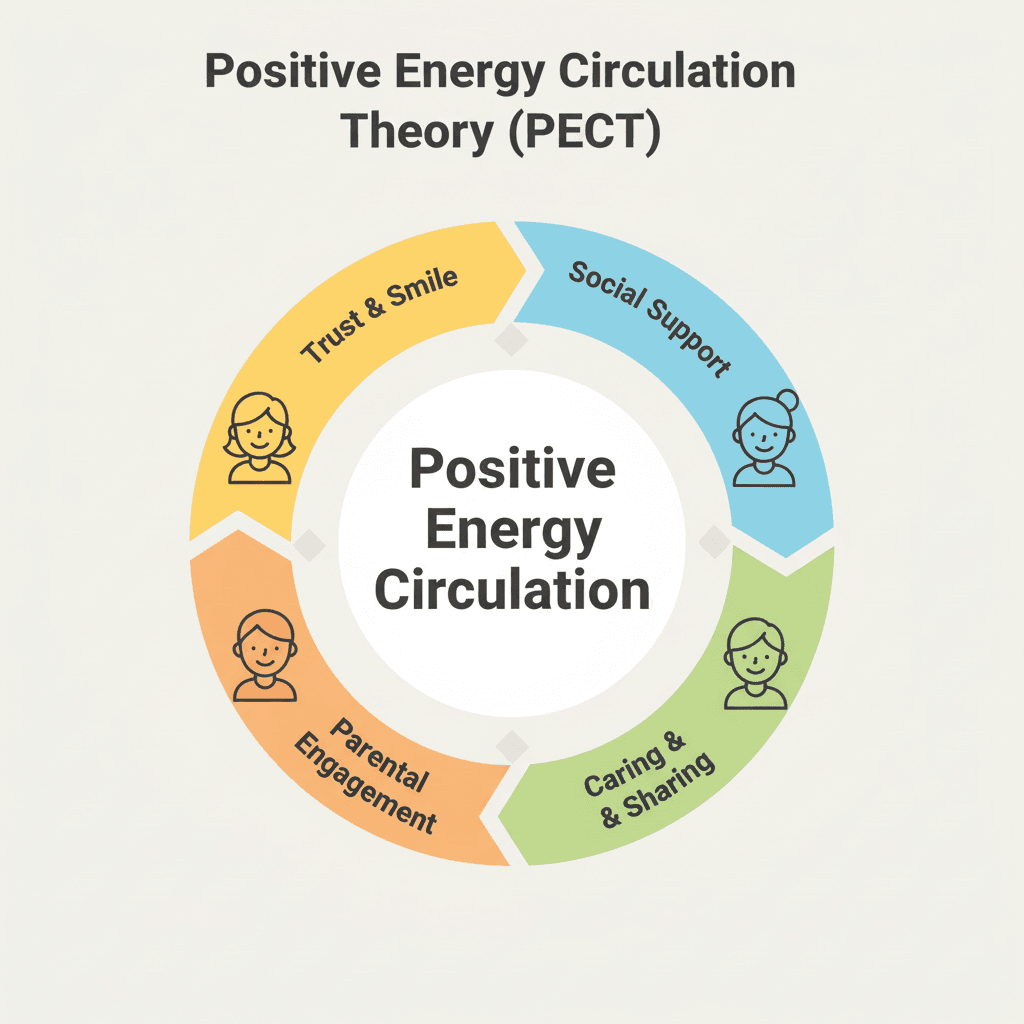
Understanding Positive Energy Circulation
This paper proposes Positive Energy Circulation Theory (PECT) as a conceptual framework for examining how encouragement, recognition and collaboration may affect motivation within groups. It sets out relationships that could be investigated in schools and other organisations. The framework requires empirical testing.
Theoretical framework
PECT builds on several established theoretical foundations:
- Positive Psychology (Seligman, 2011; Fredrickson, 2001) emphasises strengths, positive emotions, and flourishing.
- Emotional Contagion Theory (Hatfield, Cacioppo, & Rapson, 1994) explains how emotions can be transferred between individuals through social interaction.
- Social Exchange Theory (Homans, 1958) frames social interactions as transactions in which resources (emotional, informational, behavioural) are exchanged.
- Energy Management Theory (Schaufeli & Bakker, 2004) highlights the role of psychological energy in sustaining work engagement and performance.
PECT brings these ideas together in a proposal about how positive interactions may influence subsequent behaviour, motivation and collaboration within a group.
Methodology
This paper presents PECT as a conceptual framework. Future empirical validation could employ:
- Observational studies measuring interpersonal positivity and engagement in classrooms or workplaces.
- Experimental interventions implementing strategies to enhance positive energy (recognition programmes, collaborative exercises) and measuring effect.
- Surveys and psychometric tools assessing the perception, transfer, and impact of positive energy.
The methodology emphasises interdisciplinary applicability, allowing for adaptation across education, business, and social organisations.
Propositions
The framework proposes four relationships for investigation:
- Whether constructive feedback and supportive actions encourage similar responses from others.
- Whether the effects change as more people participate in these interactions.
- Whether sustained supportive interactions are associated with motivation and lower reported burnout.
- Whether these patterns are associated with collaboration, engagement and achievement at group level.
These are research propositions, not established findings. They need definitions, appropriate measures and testing before conclusions can be drawn.
Discussion
Schools interested in exploring the framework could examine existing practices such as recognition, peer support and collaborative work. These provide settings in which to study interactions and gather evidence, rather than proof that the proposed theory is effective. Possible areas of investigation include:
- Encouraging daily recognition and gratitude practices
- Structuring collaborative activities that promote shared success
- Fostering reflective practices that build awareness of positive behaviours
Future research should focus on empirical validation, exploring the measurable impact of PECT interventions on motivation, engagement, and performance across diverse contexts.
Practical implications
Possible applications in schools
Peer mentoring, recognition of contributions and collaborative activities offer practical contexts for exploring the framework. A school would need to identify the question it wants to investigate and how it will gather feedback from staff and students.
Any evaluation should consider other influences on participation and school culture. Claims about improved achievement or reduced burnout would require evidence beyond positive feedback about an activity.
Conclusion
PECT offers a proposed way to examine supportive interactions within groups. Further work is needed to define its concepts, test its propositions and establish whether it adds to existing explanations of motivation and collaboration.
References
Fredrickson, B. L. (2001). The role of positive emotions in positive psychology: The broaden-and-build theory of positive emotions. American Psychologist, 56(3), 218 to 226.
Hatfield, E., Cacioppo, J. T., & Rapson, R. L. (1994). Emotional contagion. Cambridge University Press.
Homans, G. C. (1958). Social behavior as exchange. American Journal of Sociology, 63(6), 597 to 606.
Seligman, M. E. P. (2011). Flourish: A visionary new understanding of happiness and well-being. Free Press.
Schaufeli, W. B., & Bakker, A. B. (2004). Job demands, job resources, and their relationship with burnout and engagement: A multi-sample study. Journal of Organizational Behavior, 25(3), 293 to 315.